Spiritual alchemy symbols are intricate representations that symbolize the transformative journey toward self-realization and enlightenment. These symbols reflect a deep interconnection among various philosophical traditions, revealing the shared quest for understanding and growth.
Among the most significant symbols is the Philosopher's Stone, which signifies ultimate transformation and the pursuit of perfection. This emblem encapsulates the essence of spiritual alchemy, emphasizing the potential for profound change within oneself.
Another important symbol, the Ouroboros, illustrates the cyclical nature of existence and the unity of opposites, highlighting the idea that endings and beginnings are intertwined.
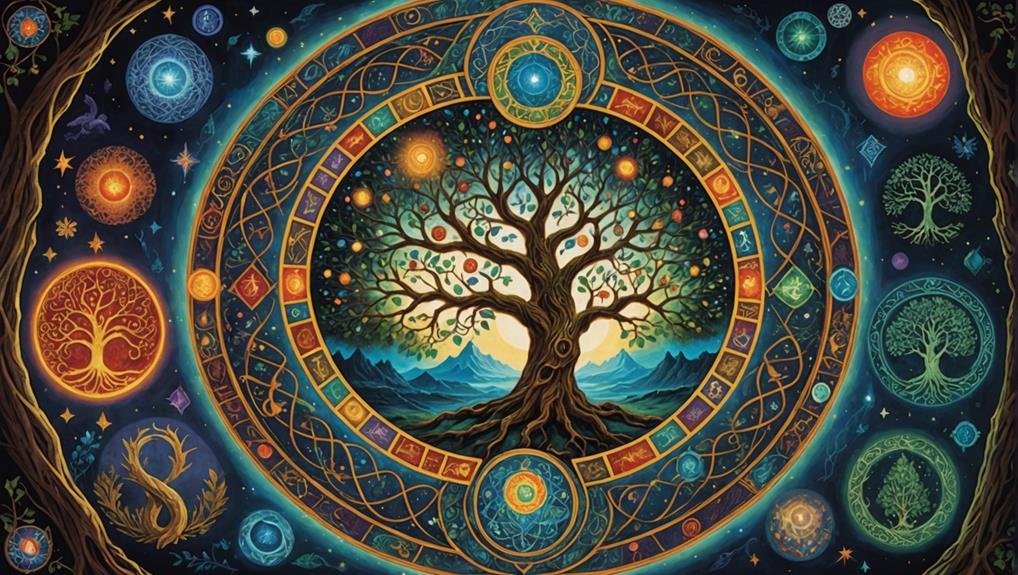
The Tree of Life is another vital symbol that embodies themes of interconnectedness and growth. It serves as a reminder of our collective responsibility to nurture and support one another on our individual paths.
Additionally, elemental symbols such as fire and water evoke concepts of purification and emotional depth, respectively, enriching the understanding of personal transformation.
Each of these symbols carries historical significance, inviting contemplation of humanity's journey toward deeper understanding and evolution through existential challenges.
By exploring these symbols, we gain intriguing insights into the mystic practice of spiritual alchemy and its relevance in our lives today.
Spiritual Insights
- The Philosopher's Stone symbolizes ultimate transformation, representing the quest for enlightenment and inner healing in spiritual alchemy.
- The Caduceus illustrates duality and transformation, embodying the union of masculine and feminine energies for personal metamorphosis.
- The Ouroboros signifies the cyclical nature of existence, highlighting the unity of opposites and the eternal nature of the universe.
- The Tree of Life embodies interconnectedness and growth, symbolizing the collective responsibility for nurturing life and ecological balance.
- Elemental symbols like Fire, Water, Air, and Earth reflect the essential qualities needed for spiritual growth and understanding in alchemical practices.
Overview of Spiritual Alchemy
Spiritual Alchemy: A Transformative Journey Towards Enlightenment
Spiritual alchemy is a transformative journey that represents the inner quest for self-realization and enlightenment. This practice embodies the concept of mystical transformation, wherein individuals seek to transmute their base instincts into higher consciousness through spiritual alchemy. The process of inner purification is paramount in spiritual alchemy, emphasizing the importance of shedding ego-driven desires and societal conditioning to achieve a more profound understanding of one's true nature.
Various spiritual alchemy symbols, such as the philosopher's stone and the ouroboros, serve as powerful representations of this transformative journey, guiding practitioners in their quest for deeper meaning and insight into their spiritual path. Unlocking spiritual alchemy reveals the significance of these symbols in representing transformation and inner growth.
Historically, spiritual alchemy has drawn from various cultural and religious frameworks, merging elements of Hermeticism, Gnosticism, and Eastern philosophies. These influences reveal an overarching narrative: the pursuit of wisdom and the cultivation of virtue as pathways to spiritual ascendance within the realm of spiritual alchemy.
As practitioners engage with symbolic representations, such as the ouroboros or the philosopher's stone, they navigate the complexities of the human psyche, often confronting inner shadows that inhibit growth in their spiritual alchemy journey.
Moreover, spiritual alchemy invites critical reflection on contemporary societal issues, urging individuals to contemplate how collective consciousness can evolve through personal transformation. By fostering a deeper connection with oneself and the universe, spiritual alchemy serves as a timeless framework for understanding the intricacies of the human experience and the potential for radical change within the context of spiritual alchemy.
The Philosopher's Stone
The Philosopher's Stone: A Symbol of Transformation and Enlightenment
The philosopher's stone serves as a powerful symbol of ultimate transformation and enlightenment in spiritual alchemy. Throughout history, the philosopher's stone has captivated the minds of alchemists, philosophers, and mystics, representing the quest for perfection and the transmutation of base substances into noble ones.
This potent symbol is intricately linked to the process of unlocking personal growth, emphasizing the potential for profound inner healing and self-discovery. In the rich history of the philosopher's stone, it is often associated with the search for the elixir of life and the ability to turn lead into gold, which embodies humanity's desire for transcendence and immortality.
The significance of the philosopher's stone goes far beyond mere material transformation; it represents the inner journey of the self towards spiritual awakening and realization.
This duality underscores the broader implications of alchemical practices, where the physical and spiritual domains intersect, urging individuals to confront their inner shadows and cultivate their true potential.
As a symbol, the philosopher's stone invites introspection and reflection on the nature of existence, encouraging a deeper understanding of one's purpose and the interconnectedness of all life.
Consequently, the philosopher's stone remains a profound emblem of aspiration, urging seekers to embark on their transformative journeys toward enlightenment.
The Ouroboros Symbol
The Ouroboros symbol, a significant representation in spiritual alchemy, illustrates the cyclical nature of existence and the concept of eternal return. The Ouroboros embodies the idea that life is a continuous cycle of creation and destruction, reflecting the interplay between beginnings and endings. The meaning of the Ouroboros extends beyond mere symbolism; it invites contemplation on how various cultures have interpreted this powerful image throughout history.
| Aspect | Description |
|---|---|
| Ouroboros History | The history of the Ouroboros originates from ancient Egypt and Greece, symbolizing the unity of opposites. |
| Ouroboros Cultures | The Ouroboros is found in Gnosticism, Hinduism, and alchemical traditions, signifying transformation. |
| Ouroboros Interpretations | The interpretations of the Ouroboros represent self-reflexivity and the eternal nature of the universe. |
| Spiritual Significance | The spiritual significance of the Ouroboros encourages introspection and understanding of one's place in the cosmic order. |
The profound nature of the Ouroboros draws attention to its recurring presence across various cultural landscapes, emphasizing the role of the Ouroboros in expressing philosophical and spiritual insights. As societies evolve, the symbol of the Ouroboros continues to inspire contemplation on renewal and the interconnectedness of all existence, serving as a reminder of the perpetual cycles inherent in life.
The Ankh and Its Significance
The Ankh and Its Significance
The Ankh is a profound symbol of life and immortality, deeply embedded in ancient Egyptian culture and its beliefs. The Ankh embodies the essence of life and immortality, signifying not only physical existence but also spiritual transcendence. Its historical significance is woven into the beliefs of a civilization that held the cycle of life and death in high regard, revealing a complex tapestry of meanings associated with the Ankh.
Often depicted in art and hieroglyphics, the Ankh serves as a potent reminder of the connection between the earthly and the divine. In various cultures, much like the representation of snakes, the Ankh signifies transformation and renewal, emphasizing the intricate interconnectedness of all life forces.
Within the realm of spirituality, the Ankh symbolizes the union of opposites, such as male and female energies, reflecting the holistic nature of existence itself. The Ankh's significance is further highlighted in cultural rituals, where it is frequently employed in ceremonies designed to invoke protection and blessings.
Its presence in art is equally crucial, as it adorns the imagery of deities and pharaohs, underscoring the revered status of the Ankh in ancient Egyptian society. Moreover, the symbolism of the Ankh transcends mere representation; it invites deep contemplation on mortality and the afterlife.
Through the lens of history, the Ankh acts as a bridge between the temporal and the eternal, encapsulating humanity's quest for understanding amidst the mysteries of existence. The Ankh, therefore, is not just a symbol but a profound expression of life's continuity and the pursuit of immortality.
The Tree of Life
The Tree of Life, a universal motif, embodies various branches of symbolism that highlight interconnectedness, growth, and renewal. The symbolism of the Tree of Life emphasizes interconnectedness, reflecting unity in diversity across many spiritual traditions. This aspect of interconnectedness illustrates how all living beings are part of a larger whole.
Moreover, the symbolism of the Tree of Life also encompasses growth, representing both personal and collective evolution. In many mythologies and folklore, this growth symbolizes the journey individuals and communities undertake throughout different life stages.
Additionally, the symbolism of the Tree of Life signifies renewal, embodying themes of rebirth and regeneration that are integral to seasonal festivals. These cycles of renewal serve as a reminder of the importance of embracing change and transformation in our lives.
Historically, the Tree of Life has been depicted in ancient texts, such as the Kabbalah, where it illustrates the profound relationship between the divine and humanity. Its representation in art and literature further emphasizes the social implications of the Tree of Life, highlighting the necessity of ecological balance and sustainability.
Thus, the Tree of Life is not just a symbol; it serves as a vital reminder of our collective responsibility to nurture the interconnected web of existence.
The Caduceus in Alchemy
The Caduceus in Alchemy: A Symbol of Duality and Transformation
The Caduceus in alchemy serves as a profound symbol of duality and transformation, embodying the union of opposites to achieve harmony. In alchemical symbolism, the Caduceus highlights the duality of opposites and the harmonious balance achieved through their union. Historically, this symbol has been attributed to Hermes, the messenger of the gods, and its caduceus history reveals its associations not only with commerce and negotiation but also with the spiritual journey of transformation and enlightenment.
In the context of spiritual psychology, the Caduceus emphasizes the importance of integrating spiritual awareness with psychological healing, underscoring the need to understand oneself on multiple levels during the transformative process.
The caduceus symbolism encapsulates key concepts within alchemical thought, manifesting in various dimensions:
- Integration of Duality: The entwined serpents of the caduceus signify the melding of opposing forces, such as masculine and feminine energies, or spirit and matter.
- Transmutation: The staff of the caduceus serves as a vehicle for the alchemical process, guiding the practitioner through stages of personal metamorphosis.
- Healing and Transformation: The caduceus is often linked to healing, embodying the potential for spiritual and physical rejuvenation.
- Wisdom and Knowledge: The symbol of the caduceus signifies the pursuit of enlightenment, emphasizing the importance of wisdom in achieving balance.
Ultimately, the Caduceus stands as a powerful emblem in alchemical tradition, inviting reflection upon the intricate relationship between opposites and the journey toward self-realization. The Caduceus, through its rich symbolism, reinforces the essential themes of duality and transformation that are central to alchemical practices.
The Elemental Symbols
Elemental Symbols in Alchemical Philosophy
Elemental symbols are fundamental representations in alchemical philosophy, encapsulating the core principles of both the material and spiritual universe. Each elemental symbol—fire, water, air, and earth—carries profound metaphysical significance that reflects the duality found in physical and astral realms.
The fire element, as an elemental symbol, is often linked to transformation and energy, representing the passionate drive for enlightenment and the purification process essential to spiritual growth. In this context, spiritual healing practices can amplify the transformative power of the fire element, guiding individuals towards enhanced self-awareness and emotional equilibrium.
Conversely, the water element, another key elemental symbol, embodies emotions, intuition, and the subconscious, illustrating the fluidity of life and the critical importance of adaptability in both individual and collective journeys.
The air element serves as an elemental symbol of intellect and communication, acting as a conduit between the material and spiritual realms, and emphasizing the vital role of thought and inspiration within the alchemical process.
Lastly, the earth element stands as a grounding elemental symbol, representing stability, manifestation, and the nurturing qualities of the physical domain.
Historically, these elemental symbols have transcended cultural boundaries, influencing a myriad of philosophical and spiritual traditions, thus underscoring the interconnectedness of all existence.
Through a critical exploration of these elemental symbols, we gain insights not only into ancient alchemical practices but also into modern spiritual inquiries, revealing their enduring influence on human consciousness and societal evolution.
The Alchemical Process Stages
The Alchemical Process Stages
The alchemical process stages represent a transformative journey toward achieving spiritual and material perfection. These alchemical process stages invite practitioners to engage deeply with their psyche, encouraging self-exploration and personal metamorphosis. By incorporating practices from spiritual healing methods, individuals can enhance their experience of these alchemical process stages, promoting emotional and physical well-being.
The alchemical process stages encompass four primary phases:
- Calcination – The breakdown of the ego, allowing for the confrontation of one's fears and limitations.
- Dissolution – Symbolizing the dissolution of rigid structures, leading to emotional release and the fluidity of thought.
- Separation – The discernment of essential truths from falsehoods, enabling clarity and insight into one's true nature.
- Conjunction – The integration of opposites, culminating in a harmonious balance that fosters spiritual enlightenment.
Through these alchemical process stages, individuals are not merely altering their external circumstances; rather, they engage in a profound internal revolution that reshapes their worldview.
Historically, these alchemical process stages reflect an understanding prevalent in medieval alchemical practices, where the transmutation of base metals into gold served as a metaphor for the elevation of the self.
Consequently, the alchemical process stages not only highlight personal development but also carry broader social implications, as they advocate for a holistic understanding of human potential.
Mystical Questions
How Do Spiritual Alchemy Symbols Differ From Traditional Alchemical Symbols?
Spiritual alchemy symbols differ from traditional alchemical symbols primarily in their symbolic interpretation and historical context. While traditional symbols focus on material transformation, spiritual symbols emphasize inner growth, personal development, and the quest for enlightenment.
Can Anyone Practice Spiritual Alchemy, or Is It Exclusive to Certain Groups?
Just as a seed can blossom into a vibrant flower, anyone can initiate the journey of spiritual alchemy. This practice fosters spiritual transformation and personal growth, transcending barriers, welcoming all seekers of enlightenment.
Are There Modern Interpretations of Ancient Spiritual Alchemy Symbols?
Yes, contemporary interpretations of ancient practices have emerged, integrating modern symbolism into spiritual alchemy. These reinterpretations often reflect current philosophical and psychological perspectives, enriching the understanding and application of these timeless symbols in today's context.
How Can I Incorporate Spiritual Alchemy Symbols Into My Daily Life?
Incorporating spiritual alchemy symbols into daily rituals can be as transformative as refining raw metal into gold. By integrating these symbols into meditation or visualization practices, individuals can facilitate profound personal transformation and self-discovery.
What Role Does Meditation Play in Understanding Spiritual Alchemy Symbols?
Meditation plays an essential role in understanding spiritual alchemy symbols by enhancing awareness and facilitating symbolic visualization. Utilizing various meditation techniques allows practitioners to internalize and interpret these symbols, deepening their spiritual insights and transformative experiences.


