Spiritual symbols are compressed meaning — images a culture has loaded with significance so they can carry an idea faster than an explanation could. Their power runs through association, memory and attention rather than through anything inherent in the object. The clearest evidence for this is that the same symbol routinely means opposite things in two different cultures.
What is a spiritual symbol, and where does the meaning come from?
The meaning comes from the culture that assigned it, and from your own history with the image — not from the object. This sounds deflationary. It is actually the key to using symbols well, because it tells you which part is adjustable.
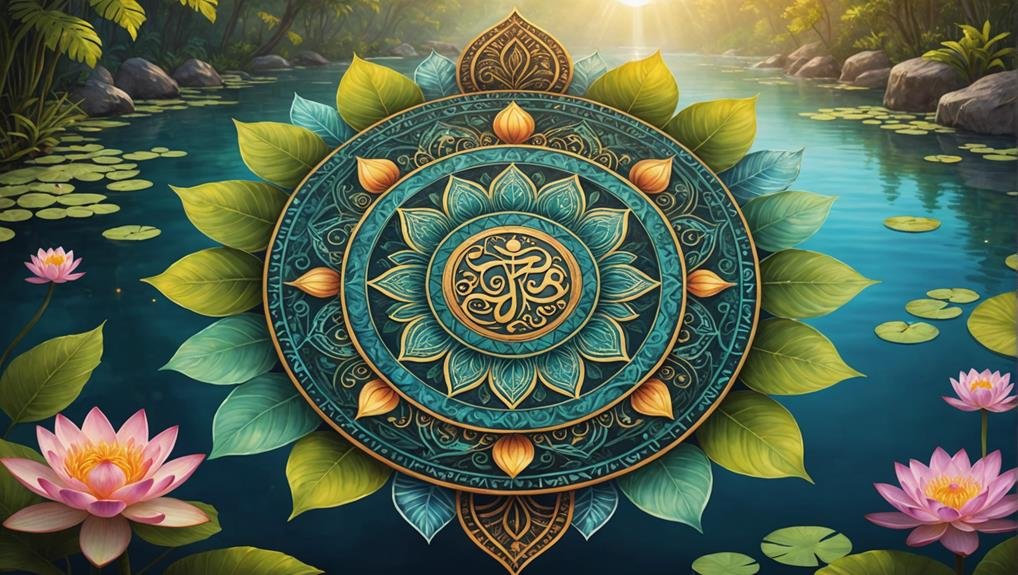
A symbol is a shortcut. “Lotus” carries something about emerging intact from filth that would take a paragraph to state and would land with less force. That compression is genuinely useful; it is why every tradition uses symbols and why they persist across centuries while the doctrines around them shift.
What a symbol is not is a mechanism. The image does not act on the world. It acts on the person looking at it, which is a smaller claim and a much more defensible one.
Why does the same animal mean opposite things in different cultures?
Because the meaning was assigned locally, by people with different relationships to that animal — and this is the single fact that most symbolism writing is built to avoid mentioning.
| Symbol | One reading | A contradictory one |
|---|---|---|
| Owl | Wisdom, insight (Greek, Athena) | Death omen, ill fortune (parts of East Africa, some Indigenous American traditions) |
| Bat | Good fortune, longevity (Chinese) | Darkness, the demonic (medieval European) |
| Crow | Prophecy, divine messenger (Norse) | Bad luck, decay (much of modern Western folk belief) |
| Snake | Healing, renewal (Asclepius, kundalini) | Deceit and the fall (Abrahamic) |
| White | Purity, weddings (Western) | Mourning, funerals (much of East Asia) |
If owls carried inherent meaning, the meaning would not invert when you cross a border. What actually happened is that people who farmed near owls and people who hunted near owls developed different associations, and each set hardened into a tradition that felt self-evident from the inside.
So when an article tells you that seeing a hawk means you are being called to a higher perspective, the honest translation is: within a particular strand of largely twentieth-century Western esotericism, hawks were assigned that meaning. That is worth knowing. It is not worth mistaking for a fact about hawks.
Why do symbols start appearing everywhere when life gets unstable?
Because loss of control measurably increases pattern detection — including patterns that are not there. This is the most useful finding in the entire subject, and it explains the experience without insulting the person having it.
In a series of experiments published in Science, Whitson and Galinsky found that people made to feel a lack of control perceived significantly more illusory patterns — images in random noise, connections between unrelated events, superstitions and conspiracies. Follow-up work found that lacking control increases identification responses to degraded visual objects generally, both accurate and inaccurate.
Read that carefully, because the popular version gets it backwards. The finding is not “you are making things up when you are stressed”. It is that the pattern-detection system runs hotter when the environment stops being predictable — which is, in most circumstances, exactly the right response. A system that looks harder for structure when structure is missing is well designed. It simply also returns more false positives.
This is why symbols cluster around divorces, bereavements, job losses and diagnoses. Not because the universe increases its output during hard times, but because you have started scanning. Both of those can be true at once, and only one of them requires the universe to be sending mail.
So do symbols do anything at all?
Yes — to you, reliably, through mechanisms that are documented. The effects are real; the explanation is just not the metaphysical one.
They make attention concrete. A symbol you have deliberately attached to an intention functions as a retrieval cue. Seeing it re-presents the commitment at moments when you were not thinking about it. This is unremarkable memory science doing genuinely useful work.
They deliver the benefits of ritual. Fieldwork on religious practice found ritual behaviour measurably reduces anxiety, and experimental work indicates the active ingredient is predictability — structured, repeatable behaviour dampens anxiety. A symbolic object embedded in a repeated sequence inherits that effect.
They can occasion awe. Vast or ancient imagery is a common trigger for awe, which has an accumulating evidence base linking it to mental and physical health.
None of this requires the symbol to mean anything cosmically. It requires you to have a nervous system and a memory, which you do.
What the evidence doesn’t support
- Universal symbol dictionaries. No good evidence supports the idea that symbols carry fixed cross-cultural meanings. The contradiction table above is the refutation. Any site offering the definitive meaning of a symbol is offering one tradition’s reading, usually without saying which.
- Symbols as protection. No evidence supports objects or images influencing events. If wearing something helps you, the mechanism is your own state — which is a real benefit, and worth having honestly.
- Jung’s collective unconscious as established science. The observation that certain motifs recur across unconnected cultures is genuine and interesting. The explanation — inherited archetypes in a shared psychic substrate — is a hypothesis with no empirical support. Shared human anatomy, shared environments and shared narrative constraints account for most of the recurrence.
- Frequency as significance. Seeing a symbol repeatedly is evidence about your attention, not about the world. Once a thing is salient you will encounter it more, because you are now filtering for it.
How do you use symbols without fooling yourself?
Assign meaning deliberately, in advance, and keep a record. This preserves everything symbols are good for while removing the part where you read your own attention as external instruction.
- Choose the symbol and write down what it means to you. Not what a dictionary says. One sentence, dated, in a notebook. You are the source of the meaning; making that explicit is the entire discipline.
- Attach it to one specific intention. “When I see this, I check whether I am rushing.” Vague attachments produce vague effects.
- Put it somewhere with a fixed trigger. The same object, the same moment each day. This is what recruits the ritual-predictability effect rather than leaving it to chance.
- Log sightings for two weeks — including the boring ones. Most people only remember the meaningful hits. Writing down every occurrence, including the ones that coincided with nothing, is the cheapest available correction for the pattern-detection bias described above.
- Review the log honestly. If a symbol keeps appearing at genuinely decisive moments, that is interesting data about what you are attending to. Read it as information about yourself, which is what it is.
One caution. If symbols are arriving with a sense of urgency or instruction — if they feel like directives rather than reminders — that is worth taking seriously as a signal about your state rather than about the message. It is also a common feature of the environments where people get recruited and exploited, because a person who reads external signs as commands is straightforward to steer.
What changed my mind about this
I spent a stretch of my late twenties convinced that a particular bird was following me. This is embarrassing to write down and it was completely sincere at the time. It appeared at decisions, at arguments, on the morning of a funeral.
What eventually dismantled it was not scepticism. It was a notebook. I started recording every sighting instead of only the ones that landed, and the shape of the thing changed within about three weeks. The bird was common in my area. I saw it constantly. What varied was not its presence but whether I happened to be in a state where I was scanning for meaning — and I was scanning almost exclusively during upheaval, which is precisely when meaningful-feeling coincidences were most available.
The part I did not expect: the symbol kept working afterwards. Knowing where the meaning came from did not switch it off. I still use that bird as a marker, and it still reliably interrupts me and makes me check what I am doing. What I lost was the belief that it was addressed to me. What I kept was a functioning attentional cue, which turned out to be the useful part all along.
Frequently asked questions
What does it mean if I keep seeing the same symbol?
Most reliably, it means the symbol has become salient to you and your attention is now filtering for it — a well-documented effect that intensifies when life feels uncontrollable. That is not nothing: it tells you something real about your current state and preoccupations. It is simply information about you rather than a message from outside.
Are there any genuinely universal symbols?
A few motifs recur very widely — light and dark, water, the serpent, the circle, the tree — but the shared element is usually the raw material rather than the meaning. Water appears everywhere because humans everywhere need it and drown in it. What each culture concluded about water varies enormously.
Is it wrong to use symbols from a tradition I’m not part of?
It depends on whether the tradition treats it as open or closed, and the honest step is to find out rather than assume. Some symbols are freely shared. Others are initiatory or belong to communities with a specific history of having sacred material taken. Ask what the symbol carries before adopting it — both out of respect and because symbols detached from their framework tend to lose the coherence that made them work.
Do dreams about symbols mean something different?
They are generated by you, so they are informative about you — usually about recent preoccupations and unresolved material rather than about the future. A recurring dream symbol is worth examining the way you would examine any disproportionate reaction: not as a coded message, but as a signal about what you are not addressing while awake.
What about numbers — are those different from symbols?
Structurally they behave the same way, though numbers have an extra wrinkle: clocks and receipts guarantee constant exposure, so the base rate of encountering any given sequence is far higher than intuition suggests. Numbers and repeating sequences are covered separately, including why 11:11 in particular is close to inevitable.
Traditional concepts on this site are presented as psychological and cultural maps rather than as physical or metaphysical fact, in line with the editorial policy. Where a claim has no supporting evidence, this site says so.