
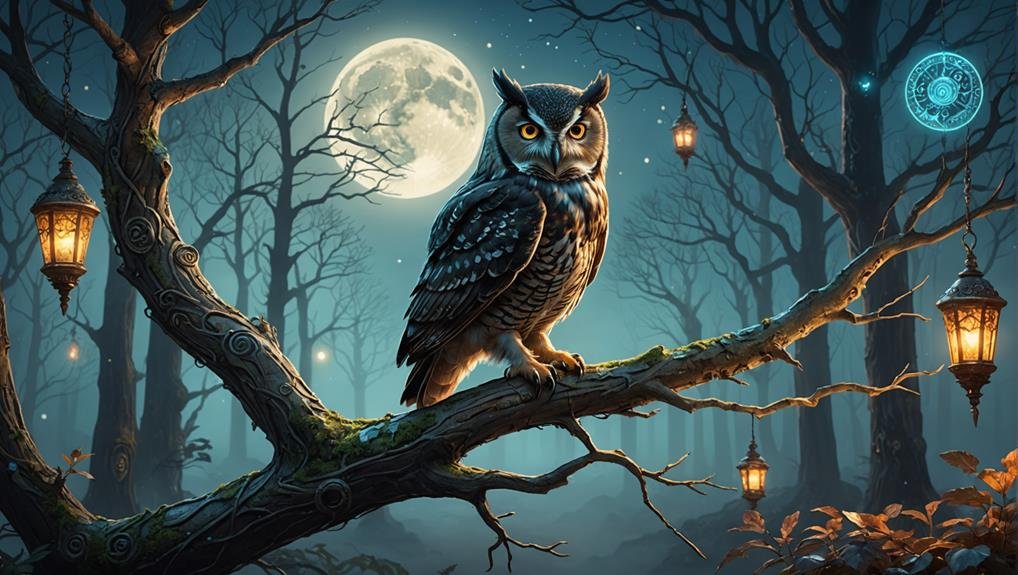
The spiritual significance of owls is a multifaceted topic that resonates across various cultures, where these creatures are often seen as symbols of wisdom, protection, and spiritual guidance. Their representation varies significantly depending on cultural context, revealing a rich tapestry of meanings that invites deeper exploration.
In ancient Greece, owls were revered as sacred to Athena, the goddess of wisdom, embodying intellect and insight. This association highlights their role as guides in the pursuit of knowledge.
In contrast, Egyptian culture viewed owls as symbols of death and the afterlife, emphasizing their connection to transformative journeys and the mysteries beyond life.
Native American beliefs further illustrate the complexity of owl symbolism. While they are seen as harbingers of insight, they also carry the weight of omens, reflecting the duality inherent in their nature.
Across Asia, owls symbolize prosperity and protection, showcasing their diverse significance in different cultural narratives.
Overall, the varied interpretations of owls across cultures underscore humanity's intricate relationship with these enigmatic creatures, as well as their enduring presence in spiritual and cultural contexts.
Spiritual Insights
- Owls symbolize wisdom and protection in Greek and Roman cultures, particularly associated with Athena, the goddess of wisdom.
- In Egyptian culture, owls represent death and the afterlife, symbolizing protection and truth during the soul's journey.
- Native American beliefs view owls as spiritual guides, embodying wisdom and insight while also serving as omens of death.
- Across Asian cultures, owls are seen as guardians against evil spirits and linked to prosperity and spiritual wisdom.
- Modern interpretations celebrate owls as symbols of awakening and self-discovery, emphasizing their role in intuitive exploration and personal transformation.
Ancient Civilizations and Owls
Owls in Ancient Civilizations: Symbols of Wisdom and Duality
Throughout history, owls have captivated the imagination of various ancient civilizations, serving as potent symbols imbued with profound spiritual significance. In cultures such as those of the Greeks and Romans, owl symbolism often represented wisdom and protection, largely attributed to their keen night vision and silent flight. The Greeks revered the owl as a sacred creature of Athena, the goddess of wisdom, and its presence was integral to ancient rituals, signifying the pursuit of knowledge and insight.
Additionally, various cultures highlight how owls were perceived as guides to deeper understanding in diverse societies.
Conversely, in ancient Egyptian culture, owls were associated with death and the afterlife, embodying the duality of existence. Owl deities, such as the goddess Mafdet, were believed to guide souls through the underworld, reflecting cultural beliefs rooted in the complexities of life and mortality.
The reverence for these nocturnal birds extended beyond mere symbolism; they were often featured in art and mythology, showcasing the interplay between nature and spirituality.
Ultimately, the multifaceted roles of owls in ancient civilizations underscore their significance as both protectors and harbingers, revealing how deeply intertwined these cultural beliefs were with societal values and existential inquiries. The owl's enigmatic presence continues to inspire reflection on the human experience.
Owls in Native American Beliefs
Owls play a vital role in Native American beliefs, representing a multifaceted symbol that encompasses wisdom, spiritual guidance, and connections to death. In many tribes, owls are revered as symbols of wisdom, possessing what is often referred to as "owl medicine." This concept encompasses the notion that owls can convey deeper insights and understanding, particularly pertaining to the unseen aspects of life and death. Their nocturnal wisdom is believed to grant individuals the ability to perceive truths that may be obscured during daylight.
| Aspect | Meaning |
|---|---|
| Wisdom | Owls symbolize deep knowledge and insight. |
| Owl Medicine | Represents protection and guidance in spiritual journeys. |
| Death | In some cultures, owls are seen as omens, often associated with death or spirits. |
The duality of the owl's symbolism illustrates the intricate relationship Native Americans maintain with nature and the spiritual domain. By embracing the owl's essence, individuals can gain profound insights into their own lives and the world around them, fostering a deeper connection to their cultural heritage and spiritual practices.
Greek Mythology and Athena
Athena and the Symbolism of the Owl in Greek Mythology
Athena's association with the owl in ancient Greek mythology underscores the bird's representation of wisdom and knowledge. Revered as the goddess of wisdom, warfare, and crafts, Athena embodies the virtues of intellect and strategic thinking. The owl, often depicted alongside her, serves as a potent symbol of her attributes. This owl symbolism reflects not only Athena's wisdom but also an intrinsic understanding of the complexities of life, encouraging individuals to seek deeper knowledge and insight.
Throughout various cultures, owls have been recognized for their spiritual significance, reinforcing the idea of their connection to intuition and foresight. Athena's wisdom was integral to her role in various myths, where she frequently guided heroes, such as Odysseus, imparting critical knowledge that led to their success.
The owl, particularly the species known as the Little Owl (Athene noctua), became synonymous with her presence, reinforcing a societal reverence for the pursuit of learning and enlightenment. Moreover, this connection suggests a broader cultural appreciation for the owl as a harbinger of foresight and understanding, transcending mere superstition.
In this way, Athena's association with the owl serves as a reminder of the enduring importance of wisdom in maneuvering through the complexities of human existence, reflecting a rich historical context that continues to resonate today.
Egyptian Symbolism of Owls
Egyptian Symbolism of Owls: A Revered Connection to Protection and the Afterlife
The ancient Egyptians held a profound reverence for owls, viewing them as powerful symbols intertwined with the themes of protection and the afterlife. These nocturnal creatures were often associated with various Egyptian deities, most prominently the goddess of wisdom, Ma'at, who represented truth and cosmic order. The owl's ability to navigate the night sky was emblematic of its nocturnal wisdom, providing a metaphorical lens through which ancient Egyptians viewed their own journeys into the afterlife.
In Egyptian culture, owls embodied a range of symbolic meanings; they were believed to safeguard the souls of the deceased as they evolved into the afterlife. Ancient rituals frequently incorporated owl imagery, highlighting their protective qualities. This connection to the spiritual domain illustrates how the owl served not merely as a creature of the night but as a crucial participant in the cosmology of ancient Egyptian belief systems.
Moreover, the representation of owls in funerary art and artifacts underscores their significance in ensuring safe passage for the departed, reflecting a society deeply engaged in the mysteries of death and rebirth.
Consequently, the owl's symbolism within Egyptian culture is rich, complex, and deeply embedded in the spiritual fabric of their civilization.
Owls in Asian Cultures
Owls in Asian cultures are rich in symbolic interpretations, often embodying wisdom and spiritual guidance, which contrasts with their depiction in other cultures such as Egypt. In many Asian societies, owls are revered as symbols of nocturnal wisdom and spiritual messengers, with spiritual mediums highlighting their importance in conveying messages from the spiritual realm.
For example, in Japanese folklore, owls are considered protective guardians that ward off evil spirits and bring good fortune, emphasizing the cultural reverence for these enigmatic creatures.
Additionally, owls are often viewed as nature spirits, embodying wisdom that resonates deeply across various traditions. In India, the owl is linked to the goddess Lakshmi, symbolizing prosperity and wisdom, which underscores their role as intermediaries between the earthly and spiritual worlds, further reinforcing their protective nature.
The dual nature of owl symbolism in Asian cultures presents a fascinating exploration of these nocturnal beings as both sources of knowledge and guardians, highlighting their significant role in the cultural and spiritual fabric of societies throughout the continent.
This rich tapestry of interpretations encourages deeper reflection on the intricate relationship between nature and spirituality.
Spiritual Guides and Intuition
Spiritual Guides and Intuition: The Role of Owls in Enhancing Inner Wisdom
Owls are often regarded as powerful spiritual guides that can enhance intuition and inner wisdom. Their owl symbolism is deeply rooted in various cultures, often embodying the qualities of nocturnal wisdom and insight. As spirit animals, owls serve as catalysts for intuition development, encouraging individuals to explore deeper into their subconscious and investigate personal insight.
This connection is not merely anecdotal; historical interpretations of owl encounters reveal a consistent theme of inner guidance and mystical connections. In many cultures, owls are also seen as protectors of sacred knowledge, often associated with the divine and the ability to see beyond the ordinary.
In many traditions, the presence of an owl is perceived as a sign to pay attention to one's dreams, where dream interpretation becomes an essential tool for understanding one's emotional and spiritual landscape.
The mysterious nature of owls, coupled with their ability to navigate the darkness, symbolizes the journey into the unknown domains of the psyche. This process fosters a heightened awareness of one's intuitive capabilities, empowering individuals to trust their instincts and embrace the wisdom within.
Ultimately, the spiritual significance of owls extends beyond mere folklore, inviting a profound exploration of the self and an acknowledgment of the unseen forces that shape our lives.
Superstitions Surrounding Owls
Cultural interpretations have profoundly shaped the superstitions surrounding owls throughout history, reflecting a complex interplay of reverence and fear. Across various civilizations, owls have been seen as both harbingers of wisdom and symbols of fear, their nocturnal mysteries giving rise to diverse owl omens. In some cultures, the sighting of an owl was considered an ill omen, often linked to impending death or misfortune, reflecting deep-seated fear factors that stem from their eerie calls and solitary habits.
Conversely, others revered these creatures as symbols of wisdom, associating them with knowledge and enlightenment, thereby creating a paradoxical relationship with the unknown.
Cultural taboos often shaped these beliefs, as societies grappled with the duality of owls as transformation symbols, representing both the shift from life to death and the quest for deeper understanding. The ambivalence surrounding owls illustrates broader themes of human experiences with mortality and the quest for meaning in darkness.
Consequently, the superstitions surrounding owls reveal not only cultural anxieties but also a complex interplay between reverence and dread, highlighting how interpretations of nature can deeply influence societal beliefs and behaviors over time.
Modern Interpretations and Practices
Modern Interpretations and Practices of Owl Symbolism
The contemporary understanding of owls reflects a transformative blend of ancient beliefs and modern insights, redefining these creatures as symbols of wisdom and spiritual awakening. While traditional owl symbolism often associated these creatures with death and the unknown, today's interpretations frequently embrace their role as symbols of nocturnal wisdom and spiritual awakening.
Across different cultures, owls have been revered as symbols of wisdom, reinforcing their connection to intuition and insight. In an era of modern mysticism, owls are increasingly celebrated within urban spirituality, serving as animal totems that guide individuals on their journeys of self-discovery and intuitive guidance.
This shift in perception highlights a broader cultural expression of the owl as a facilitator of personal transformation and enlightenment. The resurgence of interest in nature-based spirituality has prompted individuals to seek connections with animal spirits, viewing owls not merely as harbingers of doom but as messengers of deeper truths and insights.
This reinterpretation speaks to a collective desire for understanding in a fast-paced world, where the wisdom of the nocturnal can provide solace and clarity. Furthermore, as contemporary society grapples with existential questions, the owl emerges as a powerful symbol of introspection and illumination, inviting individuals to explore the shadows within themselves and fostering a more profound connection with the mysteries of life.
The Role of Owls in Literature
The Role of Owls in Literature: Owls serve as powerful symbols in literature, embodying themes of wisdom, mystery, and the duality of human nature. Throughout history, owls have captivated the literary imagination, conveying a range of meanings from wisdom to foreboding. As symbols of wisdom across cultures, owl symbolism often reflects the duality of nocturnal wisdom and the mysteries that lie in darkness, making these birds significant literary motifs across various cultures.
For instance, in Greek mythology, the owl is associated with Athena, the goddess of wisdom, highlighting its cultural representations as an emblem of knowledge and insight.
Conversely, owls frequently evoke fear and superstition in folklore narratives, embodying the mystical attributes attributed to the supernatural. In literature, they often serve as character archetypes, representing the wise mentor or the harbinger of death, thereby illustrating the complex interplay between light and shadow in human nature.
Moreover, poetic imagery surrounding owls enhances their role in storytelling, encapsulating themes of introspection and the unknown. From Shakespeare's ominous references to the owl as a symbol of ill omen to contemporary literature exploring the nuances of nocturnal life, these birds leave an indelible mark on the narrative landscape, prompting readers to reflect on the deeper meanings embedded within their presence.
Mystical Questions
Do Owls Symbolize Wisdom in All Cultures?
Do owls symbolize wisdom in all cultures? What are some specific cultures where owls are seen as symbols of protection or insight? How do different cultures interpret the significance of owls in relation to death? What are some myths or stories involving owls that illustrate their varying representations across cultures?
How Do Different Cultures View Owl Sightings?
How do different cultures interpret owl sightings? What are some specific cultural beliefs associated with owls? In which cultures are owls considered symbols of wisdom, and how does this contrast with cultures that view them as omens of death? How have historical events influenced the perception of owls in various societies? What role do owls play in folklore and storytelling across different cultures?
Are There Any Negative Connotations Associated With Owls?
What are the negative connotations associated with owls in different cultures?
How do mythical associations with death influence perceptions of owls?
What specific superstitions arise from owl sightings in various societies?
Are there particular cultures where owls are viewed more positively despite these negative associations?
How do these negative connotations impact the conservation efforts for owls?
What Is the Role of Owls in Modern Spirituality?
What is the significance of owls in modern spirituality?
How do owls represent intuitive guidance in spiritual practices?
In what ways can individuals connect with their inner selves through the symbolism of owls?
What role do owls play in various spiritual traditions and beliefs?
How can the presence of owls in nature inspire personal reflection and introspection?
What are some common interpretations of owl sightings in the context of spiritual growth?
How Can I Connect With Owl Symbolism Personally?
How can I personally connect with the symbolism of owls?
What experiences have I had with owls that could enhance my understanding of their significance?
How can I incorporate owl meditation practices into my spiritual routine?
What aspects of mystery and depth do owls represent that resonate with my life experiences?
In what ways can I invite transformation inspired by owl symbolism into my daily life?


