
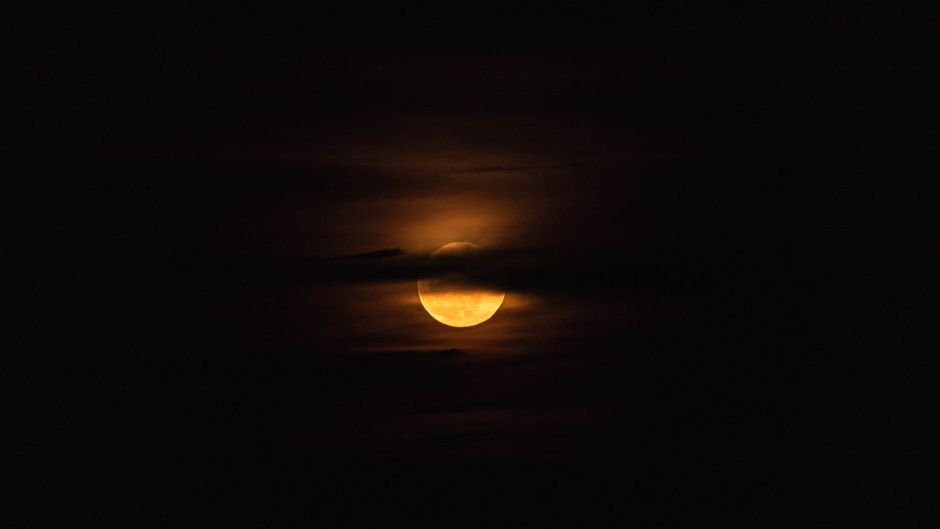
There is one piece of real lunar research worth knowing about, and it does not say what moon-manifestation content says it does. Christian Cajochen’s 2013 sleep study found a small full-moon effect — and the two large replication attempts that followed found nothing. Meanwhile the ritual itself does something the moon has no part in: it puts a recurring date in your calendar for reviewing what you want, which is a genuinely useful habit wearing borrowed clothes.
What the lunar research actually found
Cajochen and colleagues published “Evidence that the lunar cycle influences human sleep” in Current Biology in 2013. The design was unusually clean: sleep-lab data from 33 volunteers, collected years earlier for an unrelated study, in windowless rooms with no clocks and no knowledge that the moon was the question. That last detail matters — nobody could have been influenced by expectation, because nobody knew what was being looked for.
Around full moon they found roughly 20 minutes less total sleep, 30 per cent less deep-sleep EEG activity, and about five minutes longer to fall asleep. Small, but it was there, and it was well measured.
Then came the replications. Maren Cordi and colleagues reanalysed a much larger dataset — over 1,200 nights from 470 participants — and found no lunar effect. Martin Dresler’s group reported the same null result in a separate large sample. A 2015 study of over 2,000 children across five continents found no association between lunar phase and sleep duration beyond a trivial one minute.
The current honest summary: one careful small study found something, and the larger attempts to find it again did not. That is a common shape in science and it usually resolves toward no effect. It is a long way from “science confirms the moon affects us.”
Worth adding what has been tested and firmly rejected: the lunar-lunacy hypothesis. Reviews going back to James Rotton and Ivan Kelly in Psychological Bulletin in 1985 have repeatedly found no relationship between moon phase and psychiatric admissions, emergency-department volume, crime rates or births. That belief persists almost entirely because staff remember the busy full-moon nights and forget the quiet ones — the same mechanism behind repeating numbers appearing everywhere.
Where new moon and full moon rituals came from
The lunar calendar is genuinely ancient — Jewish, Islamic, Hindu and Chinese calendars are all lunar or lunisolar, and observances tied to new and full moons go back thousands of years. That much is real history.
The specific pairing you will encounter now — new moon for setting intentions, full moon for releasing what no longer serves you — is not ancient. It comes out of twentieth-century Western esotericism, particularly Wicca as reconstructed by Gerald Gardner in the 1950s, and reached its current form through the New Age publishing boom of the 1980s and 1990s. The wording is recent enough that you can watch it standardise across books published within a decade of each other.
The Lions Gate Portal is more recent still. It is dated to 8 August, framed around the star Sirius rising and the numerology of 8/8, and traced to New Age writing of the 1990s. Two things about it are checkable and rarely mentioned. Sirius’s heliacal rising is not fixed to 8 August — the date drifts with latitude and with precession, and the Egyptian association people cite corresponds to a rising that now falls closer to early August in Egypt but not on a fixed calendar day worldwide. And the astrological sign Leo, which the framing leans on, is offset from the constellation by roughly a full sign for the same reason.
None of that makes the practice worthless. It does mean it should not be described as ancient, because it is not, and a tradition that has to claim false antiquity is telling you it does not trust its own case. The same pattern shows up across how symbols acquire their meanings.
Does timing change what a practice does?
Not through the moon. But timing does something that has nothing to do with celestial mechanics, and it is worth separating cleanly.
A date on the calendar creates an implementation cue — a specific when-and-where that reliably raises follow-through on an intention, which is the finding behind implementation intentions in Peter Gollwitzer’s work and which I go through properly in what writing things down actually does. “I will review my goals on the new moon” is a better-formed plan than “I will review my goals sometime.” It has a trigger.
A lunar month is also, conveniently, about 29.5 days. That is close enough to a monthly review cycle that the practice inherits the benefits of any regular review: you notice drift, you drop things that have stopped mattering, you write down what actually happened. Businesses call this a monthly retrospective and find it useful for the same unmagical reasons.
So the ritual works, in a limited and specific sense. The moon is the calendar reminder, not the mechanism.
What to do on a full moon, if you want to do something
Here is the version I would defend. It keeps the structure and drops the claims, and it takes about twenty minutes.
At the new moon, write three things — specifically. Not “abundance.” One sentence each, in the form “when X happens, I will do Y.” If you cannot name the first action, the intention is not ready and writing it prettier will not fix that.
At the full moon, read last month’s three and mark each one honestly. Done, moved, or abandoned. Abandoned is a legitimate answer and using it is the most valuable part of the exercise — most people carry the same unstarted intention for years because nothing ever forces them to say out loud that they are not going to do it.
Then the release part, taken literally. Traditionally you write what you are letting go of and burn it. Keep the writing; the specificity is what does the work. But write the sentence underneath: what would actually change tomorrow if this were gone? If the answer is nothing, you have not released anything, you have had a feeling about it. That distinction is the whole difference between the practice being useful and being a way of feeling finished with something you have not touched.
Keep the pages. One notebook, twelve entries a year. The record is the only part that compounds, and after three or four cycles it will tell you something about your own patterns that no lunar guide can.
If a full moon makes the evening feel significant enough that you sit down and do this, that is a real benefit. Ritual lowers the activation energy for reflection. I would just rather you know which part is the ritual and which part is the moon.
If the ritual part keeps feeling hollow, the fault is usually in its construction rather than its timing — the common ritual mistakes apply on any night of the month.
Why the belief feels confirmed
Three things stack up, and none of them require the moon to do anything.
The full moon is the only phase that is unmistakable at a glance, so it is the only one you notice without checking. That makes it the only phase available for pattern-matching against a bad night’s sleep.
Bright moonlight genuinely disrupts sleep for some people, which is a lighting problem rather than a lunar one. Before electric light it disrupted a great deal more, and probably explains how the association got established in the first place.
And a monthly ritual generates one confirming instance a month for as long as you keep doing it, while the non-confirming weeks leave no record. That is the same asymmetry that keeps angel-number sightings feeling like evidence.
What the evidence doesn’t support
- That lunar phase changes the outcome of an intention. Nothing has ever tested this and no mechanism has been proposed that survives inspection.
- That the moon affects behaviour, births, admissions or crime. Repeatedly examined since the 1980s and repeatedly found absent.
- That the 2013 sleep finding is settled. Two larger datasets failed to reproduce it.
- That tides in the body mirror ocean tides. Tidal force scales with the volume of water involved; on a human-sized body it is negligible, and it does not track phase in any case — it tracks distance.
- That new moon and full moon rituals are ancient. The lunar calendar is; this pairing dates to the mid-twentieth century.
- That the Lions Gate Portal has an astronomical basis on 8 August. Sirius’s rising date is not fixed, and the sign-constellation offset is well documented.
Common questions
What should I do on a full moon for manifestation?
Review, rather than ask. Read what you wrote at the new moon, mark each item done, moved or abandoned, and write one line on what would concretely change if you let go of the thing you say you are releasing. The value is in the honest audit; the moon is supplying the reminder.
Is a new moon or a full moon better for manifesting?
Neither is better, because neither has an effect to compare. The convention pairs new moon with starting and full moon with finishing, and that pairing is useful purely as structure — a fortnight is a reasonable gap between setting something and checking on it.
What is the Lions Gate Portal?
A date, 8 August, framed around Sirius rising and the numerology of 8/8, originating in New Age writing of the 1990s. The astronomy cited does not support the fixed date. As an annual prompt to take stock it is fine; as a window during which requests are more likely to be granted, there is nothing behind it.
Does the full moon affect sleep?
Possibly slightly, possibly not at all. One well-controlled 2013 study found about 20 minutes less sleep around full moon; two much larger datasets found no such effect. If you sleep badly on bright nights, curtains are a more reliable intervention than lunar timing.
Do I need to do it on the exact day?
No — and the fact that most guides offer a three-day window either side is itself informative. A real effect with a real mechanism would have a sharp timing. A window that wide exists so the practice never fails.
Is there any harm in it?
Only in one direction: waiting. If a decision is being held until the right lunar window, the ritual has become a reason to delay. The other patterns to watch for are set out in whether affirmations work and whether vision boards do.
This article is general information, not medical advice. Nothing here is a substitute for care from a qualified professional, and no practice described should replace prescribed treatment. Sourcing and evidence standards are set out in the editorial policy.