
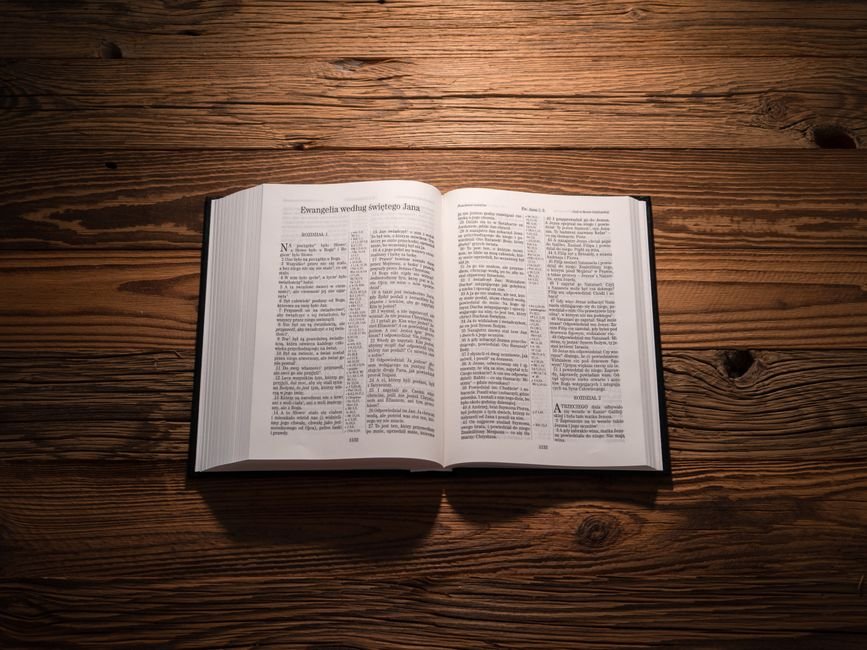
The honest answer depends on which part of manifestation you mean, and Christians do not agree. The practice of writing goals down, praying about them and working towards them has never been controversial. The metaphysical claim underneath modern manifestation — that your thoughts are a creative force that the universe must obey — is a different proposition, and it sits badly with a great deal of scripture. Below: where the practice came from, the verses used on both sides with their context intact, and where the churches actually land.
One thing first, because it matters for how you read the rest. I am not a theologian, a pastor or clergy of any tradition, and I hold no qualification in religious studies. What I can do is quote the texts accurately, give the historical record of where the teaching came from, and report what the major traditions have actually said — with links so you can check each one rather than take my word for it. The judgement is yours to make.
Where modern manifestation actually comes from
This part is documented history rather than interpretation, and it changes the question.
Manifestation as taught today descends from New Thought, a nineteenth-century American religious movement. Phineas Quimby (1802–1866) taught that illness originated in mistaken belief. Emma Curtis Hopkins trained a generation of teachers from that base. Wallace Wattles published The Science of Getting Rich in 1910, Napoleon Hill Think and Grow Rich in 1937, Norman Vincent Peale The Power of Positive Thinking in 1952. Rhonda Byrne’s The Secret (2006) repackaged Wattles for a mass market and named it the law of attraction.
New Thought was not a branch of historic Christianity, though it borrowed Christian vocabulary heavily and many of its teachers considered themselves Christian. Its core claim — mind as the primary creative power, divinity as an impersonal law you operate rather than a person you petition — is a distinct metaphysics. That is why the question keeps producing friction: the words sound familiar, and the underlying model is not the same one.
So “is manifesting a sin” is really two questions. Is it wrong to want things, name them, and act towards them? And is it wrong to hold that your thoughts are the mechanism by which reality is compelled? Almost nobody objects to the first. The disagreement is entirely about the second.
The verses used to support manifestation — and their context
Four passages carry most of the weight. Each says something; none says quite what it is quoted for.
Mark 11:24 — “whatever you ask in prayer, believe that you have received it, and it will be yours.” This is the cornerstone verse, and it is genuinely striking. The context is petition to a person: Jesus is teaching prayer, and the next verse attaches a condition about forgiving others. It is addressed to God, not to a field or a frequency. Read alongside 1 John 5:14 — confidence in asking “according to his will” — the New Testament pattern is request submitted to another’s judgement, which is structurally the opposite of a law that must deliver.
Proverbs 18:21 — “Death and life are in the power of the tongue.” Widely quoted as proof that spoken words create reality. In Proverbs, the recurring subject is speech and its consequences among people: gossip destroys, honest counsel heals, the fool’s mouth ruins him. It is wisdom literature about the social force of what you say, in a book that repeatedly warns against overconfidence in your own plans.
Proverbs 23:7 — “as he thinketh in his heart, so is he.” This one is worth checking yourself, because the context is unusually far from the usage. The passage is a warning about dining with a stingy host who is calculating the cost of your meal while pretending hospitality. Modern translations render it accordingly. It is not a statement about thought creating circumstance.
3 John 1:2 — “that you may prosper.” The verse is a letter’s opening greeting, a conventional wish for the recipient’s health, comparable to hoping this finds you well. Building a doctrine of wealth on it is a heavy load for a salutation.
Two more are used more defensibly. Genesis 1:27 (made in God’s image) is offered as grounds for humans as co-creators — a real theological conversation, though image-bearing has historically been read as dignity, responsibility and relationship rather than creative omnipotence. And Romans 12:2 (“be transformed by the renewal of your mind”) does place weight on the mind — renewed towards discerning God’s will, in that verse’s own words, rather than towards commanding outcomes.
The verses used against it
These are quoted less often on manifestation blogs, which is itself worth noticing.
James 4:13–16 is the most direct. It describes people planning a year of travel and profit, and answers: you do not know what tomorrow brings, you ought to say “if the Lord wills.” That is a rebuke aimed squarely at confident outcome-declaration. A few verses earlier, James 4:3 adds that people ask and do not receive because they ask wrongly, to spend it on their passions — a condition on prayer that the law of attraction has no room for.
Matthew 6:10, in the prayer Jesus taught, is “your will be done.” Manifestation reverses the direction of that sentence. Matthew 6:33 orders the priorities: seek the kingdom first and the rest follows — provision as a by-product, not a target.
Deuteronomy 18:10–12 prohibits divination, omen-reading, sorcery and consulting the dead. This is the passage most often cited when the question turns to witchcraft. Whether it covers a vision board is a matter of interpretation; it plainly covers ritual technique aimed at obtaining knowledge or power outside of God, which is how some manifestation practice is explicitly framed. Isaiah 47:13–14 makes the same point about astrologers.
Ecclesiastes 9:11 — “time and chance happen to them all” — is a flat denial that outcomes track merit or mindset. And the book of Job exists largely to demolish the idea that suffering reveals a fault in the sufferer. That is the pastoral heart of the objection: a doctrine where thoughts cause circumstances necessarily implies that the bereaved, the ill and the poor attracted it. Job’s friends make exactly that argument for thirty chapters and are told at the end that they have not spoken rightly.
1 Timothy 6:9–10 on the desire to be rich, and Colossians 2:8 on being taken captive by philosophy “according to human tradition,” complete the standard set.
Is manifesting witchcraft?
Usually not, in the historical sense — and sometimes yes, in the practical one. Two different things get bundled together.
Mainstream manifestation as sold on social media is New Thought positive-mind metaphysics: affirmations, scripting, vision boards, gratitude, assumption. There are no deities invoked and no spirits addressed. On the traditional definitions it is not witchcraft, and calling it that obscures what it actually is.
But a substantial part of the current scene has merged with folk and ceremonial magic: candle work, sigils, moon-phase timing, petition papers, crystal grids, deity work with named goddesses. Those are magical practices with their own lineage, and someone using them is doing something Deuteronomy 18 addresses far more directly than a collage does. If the question matters to you, the useful test is not the label on the app but whether the specific practice involves ritual technique or entities intended to compel an outcome.
Where the traditions actually land
There is no single Christian position, and pretending otherwise would be dishonest. Roughly, four:
Worth saying before the list: the split people feel here is often the one between a practice and a tradition rather than between two doctrines, which is the actual line between spirituality and religion.
Prosperity-adjacent churches teach a version of it — positive confession, speaking things into being, sowing for a return. This is a genuine and large strand, particularly in Word of Faith and parts of Pentecostalism, and its teachers would not call manifestation sin.
Most evangelical and Reformed teaching rejects it, usually on the grounds that it makes God a mechanism and the self the sovereign. The same circles have criticised prosperity theology for decades on identical grounds.
Catholic and Orthodox teaching distinguishes petitionary prayer, which is central, from divination and occult practice, which the Catechism addresses at 2115–2117 — the text names divination and magic and describes attempting to tame occult powers as contrary to the honour owed to God. Wanting good things and asking for them is not in that category; technique aimed at controlling outcomes is.
Mainline Protestant responses vary and tend to be less interested in the sin framing than in whether the theology is any good — the objection is usually that it is thin, individualistic and cruel to the suffering rather than that it is forbidden.
Beyond Christianity the shape differs again. In Islam the relevant distinction is between du’a, supplication to God, and shirk, associating partners with God — and attributing creative power to your own thought falls on the wrong side of that line for most scholars, while making du’a and then working with tawakkul does not. In Judaism, kavanah — intention — is central to prayer, but the tradition’s emphasis on action in the world and its long argument with suffering leave little room for thought-causes-circumstance. Buddhist teaching is often invoked for manifestation, which is close to an inversion: the framework treats craving as the origin of suffering, not the engine of acquisition.
The practical version, for someone who does not want to leave their faith
If you came here because you enjoy the practice and are uneasy about it, the separation is cleaner than the arguing suggests. What manifestation does that demonstrably works is not metaphysical — it is clarifying what you want, writing it down, attaching specific actions, and noticing opportunities once the goal is salient. Those mechanisms have ordinary evidence behind them and require no claim about the universe at all.
What sits in tension with the texts above is the specific proposition that your thoughts compel reality, that outcomes reflect your vibration, and that a bad outcome means you did it wrong. That last one is the part I would want anyone to drop regardless of their beliefs. It is not supported by the research either, and it does real harm to people already suffering.
What this article does not claim
- That there is one Christian answer. There are at least four, and they disagree for reasons internal to their own theology.
- That I can tell you whether something is sin. I have no standing to do that. The texts and the historical record are here so you can weigh them.
- That the law of attraction has physical support. It does not, in either direction — the quantum-physics framing is borrowed language, not a mechanism.
- That prayer has been shown to change external outcomes. The STEP trial found no benefit of intercessory prayer on recovery after cardiac surgery. Believers and sceptics both tend to overstate what the intercessory-prayer literature shows.
- That your outcomes reveal your faith or your frequency. Both versions of that idea — the religious one and the secular one — fail on the same evidence and the same passage in Job.
Common questions
Is manifesting a sin according to the Bible?
The Bible never addresses manifestation, which is a nineteenth-century American teaching. What it does address is nearby: James 4:13–16 rebukes confident declaration of future outcomes, Deuteronomy 18:10–12 prohibits divination and sorcery, and Matthew 6:10 models submission to God’s will rather than command of your own. Whether those cover the practice you have in mind is an interpretive judgement, and Christians reach different ones.
What does the Bible say about manifestation?
The word appears in older translations meaning “made evident” — as in the manifestation of the Spirit — which is unrelated to the modern usage. On the underlying idea, the texts most often quoted in favour are Mark 11:24 and Proverbs 18:21; the texts most often quoted against are James 4, Ecclesiastes 9:11 and the book of Job.
Is manifesting witchcraft?
Standard manifestation — affirmations, scripting, vision boards — is New Thought metaphysics rather than witchcraft; no entities are invoked. But much of the current scene has blended with folk magic: candle work, sigils, moon timing, deity work. Those are magical practices, and they are what Deuteronomy 18 speaks to most directly.
Is manifesting against God?
The strongest version of the objection is not about the ritual but the order of authority: manifestation places the human will as the deciding force and reality as obliged to comply, where the biblical pattern is petition to a person who may answer differently. Someone who prays for a specific thing, plans for it and works towards it is doing something the tradition has always endorsed.
Is it a sin to want money or success?
The texts are pointed about the love of money — 1 Timothy 6:9–10 — and about wealth crowding out everything else, while treating work, provision and planning as ordinary goods. The distinction drawn is consistently about what the desire has become rather than about having resources.
Can I pray instead of manifesting?
That is what most of the pastoral advice on this amounts to, and it keeps the parts that function: naming what you want specifically, returning to it regularly, and acting. What it drops is the claim that the outcome is under your control — which, for what it is worth, is also the claim the psychological research declines to support.
This article is general information, not medical advice, and not religious or pastoral counsel. Nothing here is a substitute for care from a qualified professional, and no practice described should replace prescribed treatment. Sourcing and evidence standards are set out in the editorial policy.