
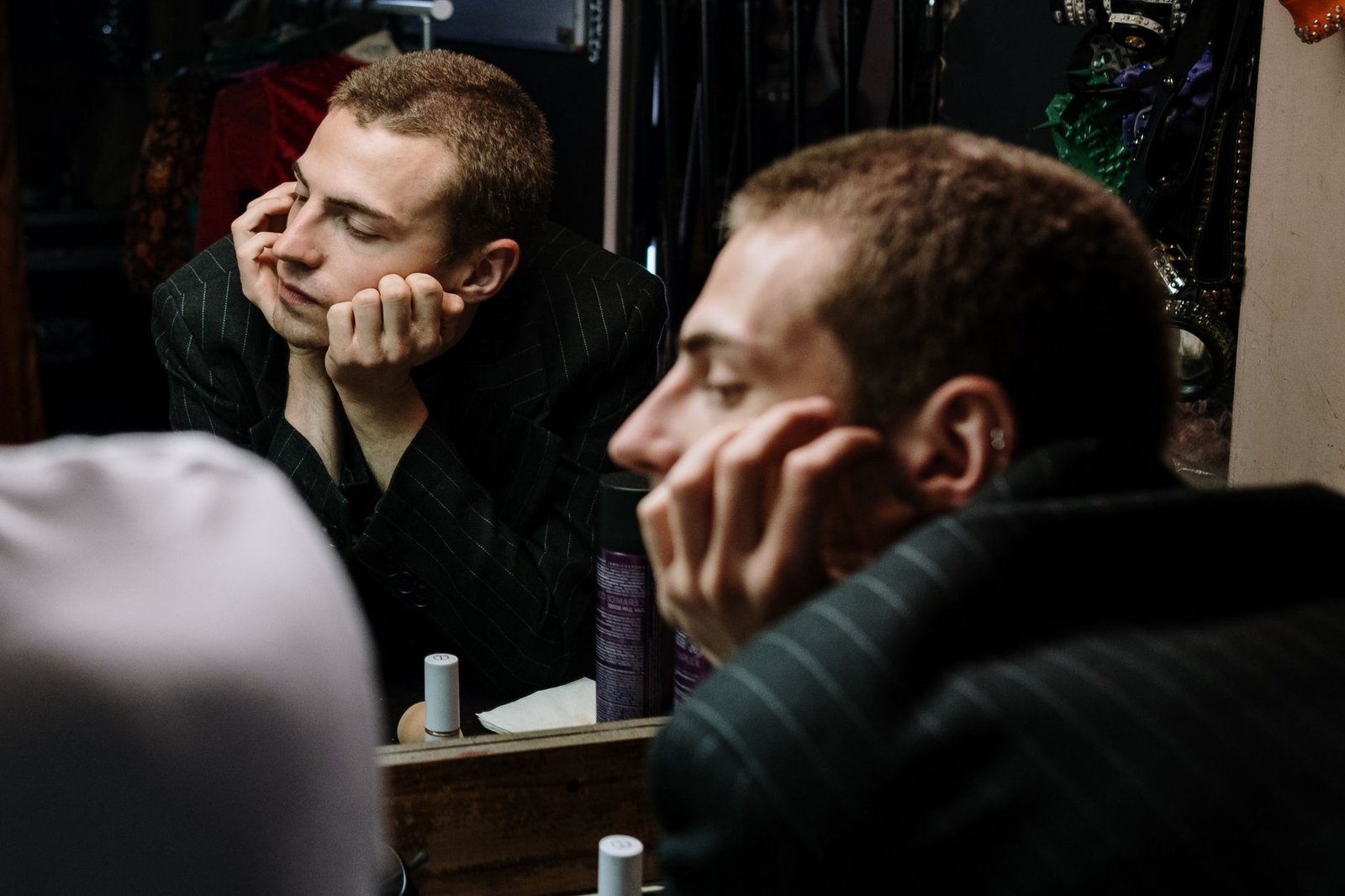
The shadow is Jung’s term for the parts of yourself you have disowned — not evil, just unacceptable to your self-image. Shadow work means noticing them, usually through what you react to disproportionately in other people. It is a useful frame, it is not an empirical finding, and its main risk is that it looks almost identical to rumination.
What is the shadow, precisely?
In Jung’s model, the shadow is everything about yourself that did not fit the person you needed to be. Some of it is unattractive — cruelty, envy, the wish to dominate. A good deal of it is not: ambition in someone raised to be modest, anger in someone raised to be pleasant, need in someone who had to be self-sufficient early.
That second category is the part worth taking seriously, and it is what people mean by the “golden shadow”. Traits get disowned for being inconvenient to your family or your role, not for being bad. Which means the contents of your shadow say more about the environment you adapted to than about your character.
Two things should be said plainly. Jung’s model is a framework, not a validated theory — there is no measurement of a shadow and no experiment that would falsify it. And it remains genuinely useful, because it points at an observable pattern: people react most strongly to traits they have suppressed in themselves.
How do you actually find it?
Through disproportion. Not what you dislike — what you dislike too much.
Ordinary dislike is proportionate and forgettable. Shadow material has a distinctive signature: the reaction is larger than the event, it lingers, you find yourself building a case, and you feel a flicker of something like satisfaction in the disapproval. That heat is the useful signal.
The mechanism does not require Jung’s metaphysics. If you paid a real cost to suppress a trait, encountering someone expressing it freely is genuinely provoking — they are getting away with something you were not allowed. The resentment is about the bill you paid, not about them.
The practical question is therefore not “what is wrong with them” but “what would it have cost me to be like that?”
The distinction that matters most
Shadow work and rumination look the same from the outside. Both involve sustained attention to uncomfortable material about yourself. One helps and one reliably makes things worse.
Rumination — repetitive, passive, circular self-focus — is associated with prolonging depressive episodes, not resolving them. The critical work on separating brooding from reflection found the two behave quite differently: reflection examines and concludes, brooding cycles the same material indefinitely.
| Shadow work | Rumination |
|---|---|
| Asks what happened and what it cost | Asks why you are like this |
| Produces a specific observation | Produces a general verdict |
| Ends in a changed action | Ends when you are tired |
| Feels uncomfortable, then lighter | Feels heavy, then heavier |
| Curious in tone | Prosecutorial in tone |
| Bounded by time | Expands to fill the day |
The single most reliable test is tone. If the internal voice is interested, it is probably shadow work. If it is prosecuting, it is rumination, and more of it will not eventually turn into insight.
Why self-compassion is not optional here
This is the part most shadow work content omits, and it is the part that determines whether the process helps.
Meeting disowned material with contempt does not integrate it. It re-suppresses it, with an extra layer of shame on top — and suppression carries a measurable physiological cost. What predicts good outcomes is the opposite posture: accepting difficult internal states without judging them, and self-compassion is strongly associated with lower psychopathology across a large meta-analytic literature.
So the harshness that feels like rigour is the thing making it not work. Unpleasant but true.
A protocol
- Keep a reaction log for two weeks. Note every disproportionate response — irritation, envy, contempt, sudden dislike. One line each. Do not interpret yet.
- Look for the repeated trait. After two weeks you will have three or four recurring themes rather than twenty incidents. The repetition is the finding.
- Ask what it cost. For each trait: where did you learn this was not allowed, and what did being without it get you? There is usually a real benefit, which is why it stuck.
- Find the 5% you could reclaim. Not the extreme version. If the disowned trait is self-assertion, the reclaimed version is one direct sentence in one conversation.
- Do the smallest experiment. Integration happens in behaviour, not insight. One action, this week.
- Stop after 20 minutes. Bounded sessions are what keep reflection from becoming brooding. Set a timer and mean it.
Projection is the engine throughout, and the wider psychological frame is in the guide to spiritual psychology. Where the disowned material is inherited from family patterns rather than personal history, that is a related but distinct process.
What this actually looked like for me
My most useful piece of shadow work came from an entirely disproportionate dislike of a colleague who talked about their own work constantly.
I had a whole case built. It was well-evidenced and, I still think, partly accurate. What made me look again was the size of it — I was thinking about this person on weekends, which is not a proportionate response to someone being a bit much in meetings.
What was underneath was not admirable. I had spent years believing that good work announces itself and that self-promotion is vulgar, which had the convenient effect of meaning I never had to risk saying my work was good and being disagreed with. Their behaviour was not offending my values. It was demonstrating that my principle had been protecting me from something.
The reclaimed 5% was sending one email describing a project I had finished, without hedging it. It was genuinely uncomfortable and completely unremarkable to everyone else. The dislike of the colleague dropped by about half within a month, which is the part I did not expect and which convinced me there was something to this.
What the evidence doesn’t support
- That the shadow is a real psychic structure. It is a model. A productive one, but not a measured entity.
- That everything you dislike is a projection. Some people are genuinely behaving badly. Treating all judgement as projection removes your ability to assess anything.
- That catharsis integrates the shadow. Expressing anger to discharge it has not held up well; it tends to rehearse rather than release.
- That shadow work treats trauma. It is not trauma therapy, and unstructured excavation of traumatic material without support can make things worse.
- That integration is ever finished. New material surfaces as circumstances change. Anyone claiming to have completed this is describing a self-image, which is the thing that generates shadows.
Is shadow work dangerous?
For most people, no. For some people, in some circumstances, yes — and the honest version of that answer is more specific than either the people selling it or the people warning against it tend to give.
Shadow work is not inherently risky the way, say, an intensive hyperventilation practice is. It is journalling and self-observation. The risk is not in the activity, it is in who is doing it, with what material, and with what support. Four failure modes account for nearly all of the harm.
- It becomes rumination. This is by far the most common one, and the whole first half of this article is about telling them apart. Rumination is associated with prolonging depressive episodes. Someone brooding daily while believing they are doing depth work can get meaningfully worse over months.
- It reopens trauma without containment. Structured trauma therapies work partly because of pacing and a second person in the room. Excavating traumatic material alone, at speed, with no plan for the rest of the evening, removes both.
- It produces shame rather than discomfort. Discomfort is the expected cost. Shame is a different state — it collapses the distinction between what you did and what you are, and it does not resolve by being examined harder.
- It becomes a licence. Naming an impulse as shadow and then acting on it is the inverse of integration. This one damages other people rather than you, which is why it rarely appears on lists of risks.
Practical guardrails, in order of how much they matter: bound the sessions with a timer, keep something ordinary planned for afterwards, write about specific events rather than about your character, and stop for a fortnight if the material is following you into your sleep. If you have a history of trauma, dissociation, psychosis or serious depression, this is work to do alongside a therapist rather than instead of one.
The distinction worth holding on to: uncomfortable and getting somewhere is the process working. Heavy, circular and worsening over weeks is not a deeper stage of the process. It is the sign to stop.
When to do this with a professional
If the material involves trauma, if you have a history of depression or dissociation, or if the log produces overwhelming shame rather than discomfort, do this with a therapist rather than alone. The failure mode of solo shadow work is a person with depressive rumination convinced they are doing depth work, getting steadily worse while feeling they are being brave.
If you are using it to justify behaviour — “this is my shadow, I am integrating it” — that is not integration. Integration means knowing the impulse is yours and still choosing what you do.
Frequently asked questions
What are shadow work prompts good for?
Getting started, mainly. Generic prompt lists tend to produce generic answers; a log of your own real reactions produces material specific to you. Use prompts if a blank page stalls you, then move to observation.
How long does shadow work take?
A single recurring pattern can shift in weeks once you act on it. The process as a whole does not end, because new material surfaces whenever your circumstances or roles change.
Can shadow work make you feel worse?
Temporarily, yes — it involves looking at things you avoided for reasons. Worse for a few days is normal. Worse for weeks, with heaviness rather than discomfort, usually means it has become rumination.
Is the shadow the same as being a bad person?
No. Much of what gets disowned is neutral or positive — ambition, anger, need, desire — suppressed because it was inconvenient in a particular family or role, not because it was wrong.
General information, not psychological advice, and not a substitute for therapy. If this surfaces trauma or persistent low mood, please speak to a qualified professional. Sourcing standards are in the editorial policy.